Want to raise a lil' bilingual bookworm?
Join 20,000+ families getting our storytime picks, tips, and inspiration every week.
"Should I stop reading Spanish books to my daughter? My pronunciation isn't great, and I don't want to mess her up."
If you've ever had this thought, you're not alone.
Many non-native parents worry that their "imperfect" Spanish—the accent, the grammar mistakes, the moments when you can't remember the right word—will somehow harm their child's language development.
But here's what the research actually shows: you're worrying about the wrong thing.
What Researchers Found About Non-Native Parents
Multiple studies on bilingual language development have explored this exact question: Do children of non-native parents end up at a disadvantage?
The answer might surprise you.
The Parent Involvement Factor
A comprehensive study published in Frontiers in Psychology examined language development in bilingual children from immigrant families. One of their key findings:
"Parent involvement in their children's learning and development has been found to positively impact academic achievement, frequently even more than the family's socioeconomic status" (Amatea, 2013, as cited in Mak et al., 2023).
Read that again.
Your involvement in your child's language learning matters more than your income level. More than your educational background. And yes—more than whether your Spanish is "perfect."
The Emotional Connection Trumps Perfect Grammar
Research from multiple bilingual parenting studies consistently shows something fascinating: parents should speak to their children in the language they feel most comfortable and confident using—even if it's not their native language.
Why?
Because confident, comfortable communication creates emotional connection. And emotional connection is what makes language stick.
When you're relaxed and natural with your child, you:
- Talk more
- Engage more deeply
- Create positive associations with the language
- Model that language is for connection, not performance
One researcher studying bilingual families put it simply: "Parents should speak a language which they feel comfortable in and which allows them to express themselves freely with their children and thus create the important bond between a parent and a child" (Rosenback, 2021).
The Success Stories You Haven't Heard
While research on native vs. non-native input shows that native speakers do provide richer vocabulary and more complex syntax (Hoff, Core, & Shanks, 2020), there's a growing body of evidence that non-native bilingual parenting (NNBP) can and does work successfully.
Christine Jernigan, author of Family Language Learning, raised her two children bilingually in Portuguese—a language she learned as an adult. Her children are now fluent.
When asked about accent concerns, she said: "I really don't see accent as an issue, as long as it doesn't interfere with comprehension... I tell parents not to worry about their accent in the second language."
Her children played with native Portuguese speakers in Brazil. If they said words differently, they were gently corrected—but it was never discouraging. Just matter-of-fact.
What Actually Matters: The Three Cs
Based on the research and successful NNBP families, here's what really determines whether your child becomes bilingual:
1. Consistency
The single most important factor in non-native bilingual parenting is consistency. Children need regular, predictable exposure to the language.
This means:
- Speaking Spanish at the same times every day (bedtime, meals, car rides)
- Reading Spanish books regularly
- Not switching back to English out of convenience
Research shows that "quantity of language exposure accounts for 50% of the variance in children's Spanish expressive vocabulary scores" (Place & Hoff, 2011).
More exposure = better outcomes.
2. Confidence
When you speak Spanish confidently—even with mistakes—your child picks up on that confidence.
When you speak hesitatingly, apologizing for errors, switching to English when it gets hard? Your child learns that Spanish is difficult, uncomfortable, and optional.
The message matters more than the grammar.
3. Connection
Language learning happens best in the context of warm, engaging relationships.
This is why your "imperfect" Spanish with lots of love and attention beats "perfect" Spanish delivered mechanically or stressfully.
Studies on shared book reading show that the emotional quality of the interaction—the cuddling, the pointing, the back-and-forth—matters as much as the words themselves for language development (Dexter & Stacks, 2014).
What About the Research Showing Native Input Is Better?
You might be thinking: "But I've read that native speakers provide better language input!"
You're right. Research does show that native speakers typically use richer vocabulary and more complex grammar when speaking to children (Hoff, Core, & Shanks, 2020).
But here's the nuance:
Native input being "better" doesn't mean non-native input is "bad" or ineffective.
Think of it this way:
- Native input = A+ quality
- Consistent non-native input = B+ quality
- No input because you're too worried about being perfect = F
B+ beats F every single time.
Plus, your child will likely get native-level input from other sources: grandparents, community members, media, and eventually school. Your role isn't to be their only source—it's to be their consistent, loving source.
Practical Strategies for Non-Native Parents
Start With Books
One of the most effective strategies for non-native parents is reading aloud in Spanish.
Why books work so well:
- The language is already correct (you're not making it up)
- You can practice pronunciation beforehand if you want
- Repetition through re-reading helps YOU learn too
- Picture books provide context clues for words you might not know
- It creates a special ritual that doesn't depend on perfect fluency
Pro tip: Start with books that have repetitive text or rhymes. The rhythm makes them easier to read aloud, and kids love the predictability.
PS: This is exactly what we do at Sol Book Box — we find the books so you don't have to:
“It's like having a Spanish-speaking pen pal for my son, and my own Spanish has improved...”
Laura B., subscriber ★★★★★
Use Your "Limitations" as Learning Opportunities
Don't know a word? Model problem-solving:
- "Hmm, I'm not sure how to say 'caterpillar' in Spanish. Let's look it up together!"
- This teaches your child that language learning is ongoing—even for adults
- It shows that not knowing everything is okay
Focus on High-Frequency Moments
You don't need to speak Spanish 24/7. Focus on:
- Bedtime routine: Songs, books, "dulces sueños"
- Meals: Food vocabulary is practical and repetitive
- Car rides: Perfect for songs and conversation
- Bath time: Action words ("splash," "wash," "rinse")
Consistency in these moments matters more than perfection throughout the day.
Supplement With Native Input
Since you're aware that native input is valuable, actively seek it out:
- Spanish-language TV shows or movies (not just translations—authentic content)
- Playdates with native Spanish-speaking families
- Community events, libraries with Spanish storytimes
- Video calls with Spanish-speaking relatives or friends
Your child can have BOTH your consistent, loving Spanish AND exposure to native speakers. It's not either/or.
The Permission You're Looking For
If you're reading this and thinking, "But what if I'm not good enough?"—here's your permission slip:
You are enough.
Your child doesn't need a Spanish teacher. They need a parent who cares enough to try.
They need someone who reads to them in Spanish, even with an accent.
Someone who sings "Las Mañanitas" off-key.
Someone who makes up silly Spanish words when they can't remember the real ones.
Someone who shows them that Spanish isn't about performance—it's about connection.
That someone is you.
What About Grammar Mistakes?
"But won't my child learn my mistakes?"
Here's the thing: even native speakers make "mistakes" or use regional variations. Language is messy and alive.
Plus, research shows that children are remarkably good at self-correction when they get additional input from other sources. They won't be "stuck" with your errors.
One study of bilingual children found that even when parents code-mixed (switched between languages), children still developed both languages normally—especially when they had enough total exposure to each language (Byers-Heinlein, 2013).
Your mistakes are not as powerful as you fear.
The Real Risk: Not Trying At All
Want to know what actually harms bilingual development?
Not inconsistent grammar. Not accented pronunciation.
Giving up.
Research consistently shows that children in immigrant families are at high risk of losing their heritage language if it's not actively maintained at home (Nesteruk, 2010).
The real tragedy isn't that your Spanish isn't perfect.
It's if your child never hears Spanish from you at all because you were too worried about being perfect.
Moving Forward: Your Action Plan
If you're a non-native parent who wants to raise a bilingual child, here's your roadmap:
Week 1: Commit to Consistency
- Choose ONE daily time for Spanish (bedtime is ideal)
- Get 2-3 Spanish books appropriate for your child's age
- Read them every single night, even if it feels awkward at first
Week 2-4: Build Confidence
- Keep reading nightly
- Add Spanish songs or simple phrases ("buenos días," "te quiero")
- Notice your child's responses—they're listening, even if they don't speak yet
Month 2-3: Expand Input
- Add a second Spanish time (maybe meals or car rides)
- Find native-speaker input sources (TV, playdates, community events)
- Celebrate small wins—did they understand a command? Repeat a word?
Ongoing: Stay the Course
- Remember: consistency beats perfection
- Don't quit during the "silent period" when they seem resistant
- Trust the research—your involvement matters more than your accent
Finding the Right Books
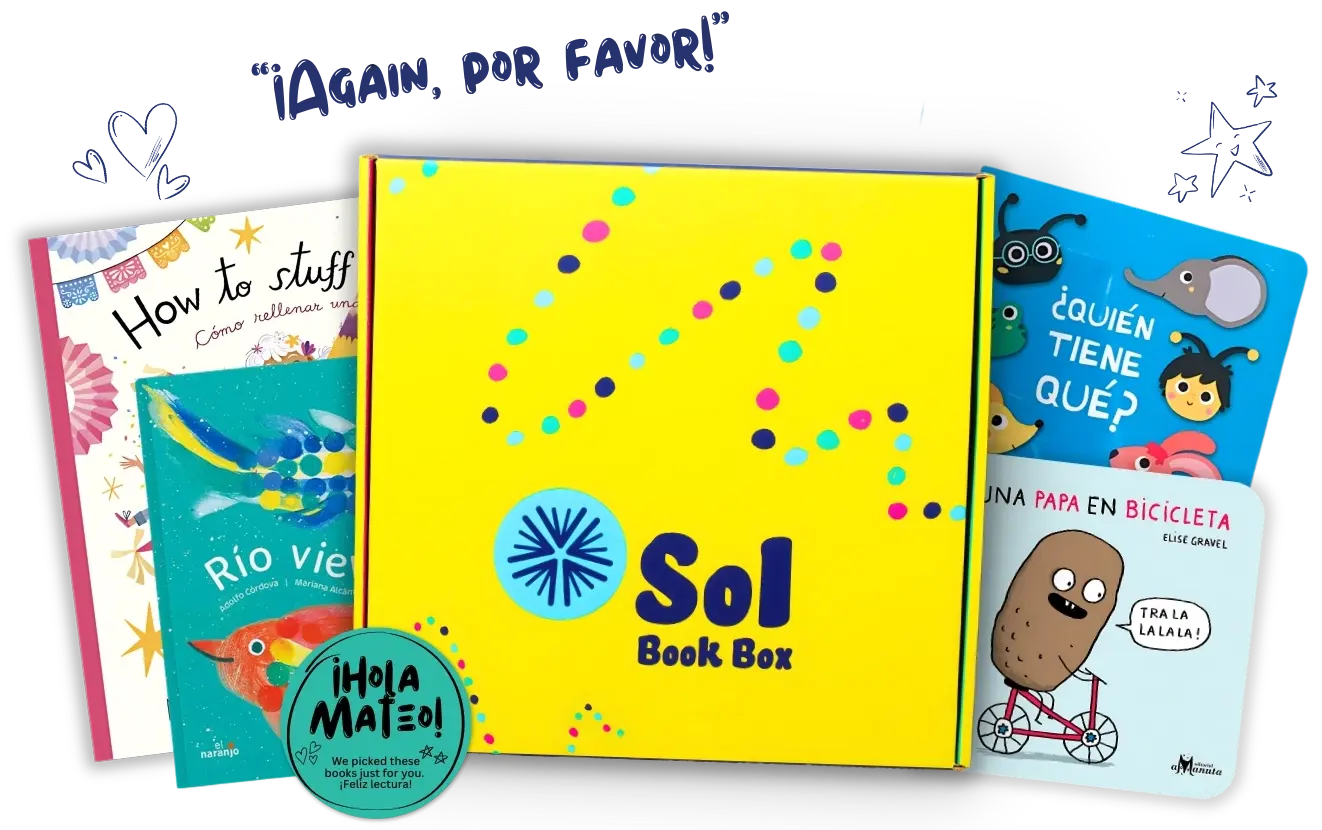
One of the biggest challenges non-native parents face is finding high-quality Spanish books that:
- Are age-appropriate and engaging
- Use authentic Spanish (not awkward translations)
- Represent diverse Latinx cultures
- Are the right length for daily reading
This is exactly why Sol Book Box exists.
We curate authentic, beautiful Spanish books from across the Spanish-speaking world and send them directly to families like yours. Every book is chosen specifically for its quality, cultural richness, and appeal to young readers.
Because we believe that every child deserves to grow up bilingual—and every parent deserves support along the way, whether your Spanish is native-level or still growing.
The Bottom Line
Your "broken" Spanish isn't broken.
It's brave.
And according to research, your consistent, loving effort matters more than perfect grammar ever will.
So go ahead. Read that book with your accent. Sing that song off-key. Mix up those verb tenses.
Your child won't remember your mistakes.
They'll remember that you tried. That you cared. That Spanish was the language of your love.
And that? That's what creates bilingual kids.
References
Amatea, E. S. (2013). Building culturally responsive family-school relationships. Pearson.
Byers-Heinlein, K. (2013). Parental language mixing: Its measurement and the relation of mixed input to young bilingual children's vocabulary size. Bilingualism: Language and Cognition, 16(1), 32-48.
Dexter, C. A., & Stacks, A. M. (2014). A preliminary investigation of the relationship between parenting, parent-child shared reading practices, and child development in low-income families. Journal of Research in Childhood Education, 28(3), 394-410.
Hoff, E., Core, C., & Shanks, K. F. (2020). The quality of child-directed speech depends on the speaker's language proficiency. Journal of Child Language, 47(1), 132-145.
Mak, E., Vanni, N. N., Yang, X., Lara, M., Zhou, Q., & Uchikoshi, Y. (2023). Parental perceptions of bilingualism and home language vocabulary: Young bilingual children from low-income immigrant Mexican American and Chinese American families. Frontiers in Psychology, 14, 1059298.
Nesteruk, O. (2010). Heritage language maintenance and loss among the children of Eastern European immigrants in the USA. Journal of Multilingual and Multicultural Development, 31(3), 271-286.
Place, S., & Hoff, E. (2011). Properties of dual language exposure that influence 2-year-olds' bilingual proficiency. Child Development, 82(6), 1834-1849.
Rosenback, R. (2021). Q&A: Should parents always speak their native language with their children? Multilingual Parenting. Retrieved from multilingualparenting.com