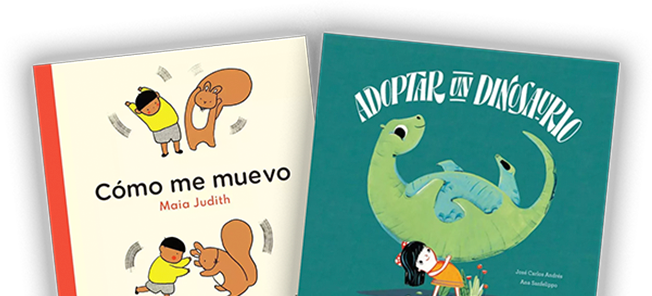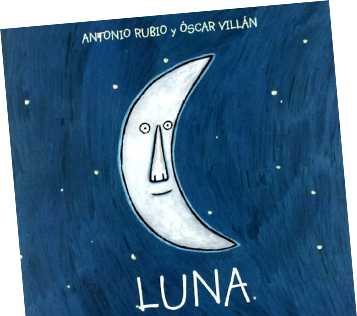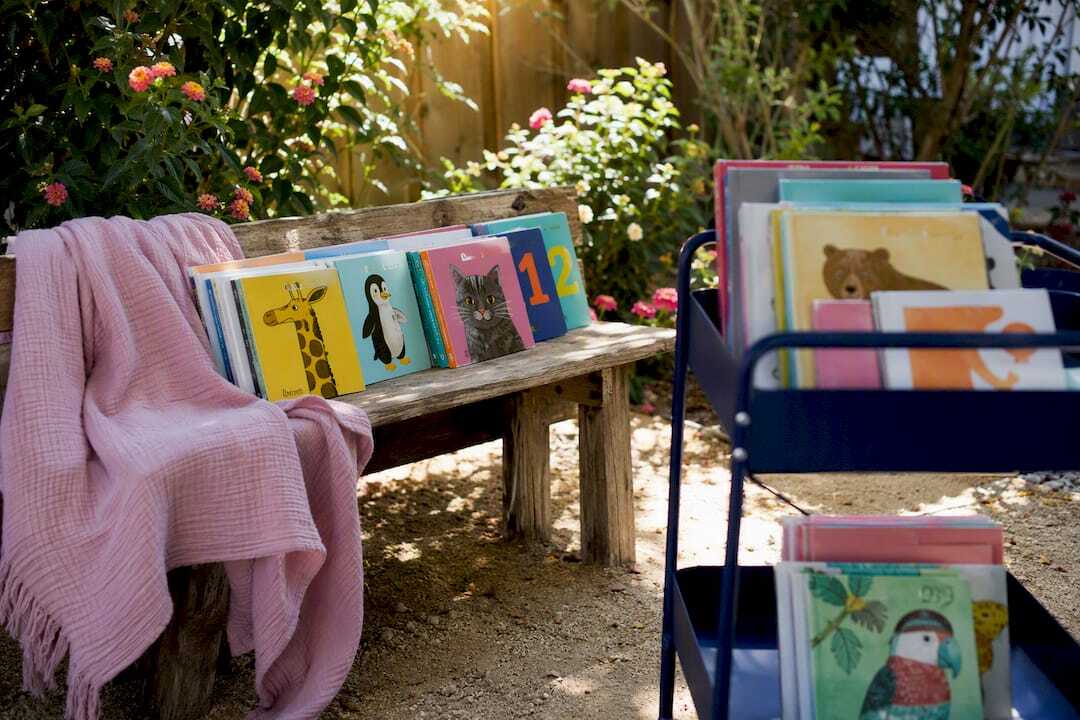
Start with curated Spanish and bilingual picture books, board books, and leveled readers matched to your child's age, and build a five-minute read-aloud habit around them. That single move does more for early bilingual literacy than any app or worksheet. The sections below show you how to choose and use them starting today.
Quick answers
- Use board and picture books with guided-reading levels A through D that feature repetition, predictable phrasing, and familiar cognates to match a kindergartener's decoding skills.
- Select books that use authentic Spanish by native authors, so sentence structures read naturally and illustrations carry the meaning of new vocabulary.
- Rotate across formats — board, picture, bilingual, leveled, and interactive — rather than relying on any single type.
- Check that chosen books are age-appropriate and reflect the regional dialect that matters to your family, if cultural authenticity is a priority.
- Consider a curated subscription like Sol Book Box to skip the title-by-title research entirely.
On this page
- What makes a Spanish book right for kindergarten?
- Kindergarten-ready Spanish books by category
- Where to find Spanish books for kindergarteners
- How to read Spanish books aloud with a kindergartener
- Getting parents and caregivers involved at home
- Choosing books across Spanish dialects and regions
- What curation actually solves
What Makes a Spanish Book Right for Kindergarten?
Not every Spanish book on a shelf belongs in a five-year-old's hands. Kindergarteners need books built for their exact stage: short attention spans, growing vocabulary, and a hunger for pictures that tell half the story before they've even sounded out a word.
Look at reading level first. Board and picture book formats with guided-reading levels A through D usually mean short sentences, repeated sentence patterns, and controlled vocabulary. Those levels aren't arbitrary. They map to what a beginning reader can decode without hitting a wall of frustration.
Text features matter just as much as format. A strong kindergarten Spanish book leans on repetition — "Buenas noches, Luna. Buenas noches, Estrella." — and predictable phrasing that lets a child anticipate the next line before you even read it aloud. Cognates help too. Words like elefante, tigre, and familia let kids lean on English knowledge they already have.
Illustrations should do real work, not just decorate the page. If a word like salta appears, the picture on that page should show a child jumping so the meaning lands even before the vocabulary does.
Authenticity is where a lot of shopping carts go wrong. A book originally written in Spanish, by a Spanish-speaking author, usually reads more naturally than a book translated word-for-word from English. Direct translations often carry stiff sentence structures that don't sound like anything a real Spanish speaker would say, and School Library Journal has flagged this as a recurring quality gap in the U.S. market.
Here's what to check before you buy or borrow:
- Board book format with rounded corners and thick pages for kids who still handle books roughly
- Guided-reading level A to D printed on the back cover or in the publisher's catalog
- Repeated phrases or a predictable refrain that repeats at least three times
- Cognates or familiar-sounding words woven naturally into the story
- Original Spanish text rather than a direct translation, when you can tell the difference
- Bilingual layout (side-by-side or alternating pages) if you want English support built in
Pro tip: Flip to a random page in the middle of the book, not just the cover, before you decide. Publishers put their best illustrations up front. The middle pages tell you whether the book holds a five-year-old's attention all the way through.
Kindergarten-Ready Spanish Books by Category
You don't need fifty titles. You need the right five or six, organized by what they're actually for. Here's a shortlist broken into the categories that matter most for kindergarten-aged readers.
1. Board and first-concept books
These are your earliest, sturdiest picks, ones a kid can hold, chew on the corner of, and survive dropping in the bathtub.
Look for first-concept board books built around colors, numbers, or animals, since these titles typically use one or two words per page. That makes them ideal for a child just starting to connect Spanish sounds to meaning. Use them for quick vocabulary building, not full read-aloud sessions. Point, name, repeat.
2. Picture books for read-aloud time
This is where the real storytelling happens, and where kindergarteners fall in love with Spanish narrative rhythm.
Look for picture books with a clear plot arc: a problem, a few attempts, a resolution. Kindergarten attention spans handle a moderate number of pages of story well. Anything longer needs exceptionally strong illustrations to hold focus. Use these for evening read-alouds, and let the pictures carry meaning when vocabulary outpaces what your child already knows.
3. Bilingual and dual-language picture books
Bilingual picture books, printed with Spanish and English on the same page or in alternating spreads, work well for mixed-language households and classrooms with varying home languages. Colorín Colorado maintains a curated booklist that highlights several strong bilingual titles built specifically for young children, with notes on age range and classroom use.
Use these when you want to reinforce Spanish while a child is also building English skills at school. Read the Spanish side first, then let the English side confirm the meaning rather than replace it.
4. Leveled readers (guided-reading levels A through D)
If you're a teacher or a parent trying to track measurable progress, leveled readers are your workhorse. Series built around leveled sets pair simple, decodable Spanish text with kindergarten-relevant themes: picnics, seasons, family routines, at controlled reading levels.
Use these for guided practice sessions, one-on-one reading time, or classroom small-group instruction. They're built to be read multiple times, with the child taking over more of the reading load each pass.
5. Interactive, search-and-find, and concept books
Books with flaps, textures, or search-and-find puzzles ("¿Puedes encontrar el gato?") keep restless five-year-olds engaged longer than straight narrative text.
Use these as a change of pace between story sessions, or as a reward activity after finishing a longer picture book. They're also strong tools for vocabulary review, since the search-and-find format naturally repeats target words multiple times per page.
Suggested rotation for a week:
- Two picture book read-alouds
- One leveled reader practice session
- One interactive book for variety
- One board book review session focused purely on vocabulary
That mix covers narrative comprehension, decoding practice, and pure word-building without any single format overstaying its welcome.
Where to Find Spanish Books for Kindergarteners
You have more options than the Spanish-language shelf at your local big-box bookstore, which, let's be honest, is usually three feet wide and mostly translated bestsellers.
Free and digital resources: Institutional booklists give you vetted title recommendations with age and usage notes at no cost. Many public library systems also offer digital collections through apps that include Spanish-language kindergarten titles alongside their English catalogs.
Library strategies: Put books on hold before you need them, especially around back-to-school season when demand for Spanish titles spikes. Ask your branch about interlibrary loan if your local system's Spanish collection is thin. Bilingual storytime events, common at libraries in areas with strong Spanish-speaking communities, are also a chance to preview books before committing to a purchase.
Classroom and leveled-reader publishers: Series built around guided-reading levels are designed for teachers who need decodable, level-matched practice texts. School Library Journal notes that several publishers have expanded catalogs specifically aligned to classroom curriculum and reading levels.
Curated subscriptions: If the research itself is the bottleneck, a curated Spanish book subscription hands you vetted, age-matched titles every month without the shelf-by-shelf hunt.
Buying tips: Before you buy, look for sample pages online. Check whether the guided-reading level is listed anywhere in the product description. If a book doesn't disclose it, that's often a sign the publisher isn't targeting the education market specifically, which matters if you need something curriculum-aligned.
- Preview sample pages before buying whenever a retailer offers them
- Confirm the guided-reading level is stated somewhere in the listing
- Check the publisher's catalog for other titles in the same series
- Ask your child's teacher which leveled-reader series the classroom already uses
How to Read Spanish Books Aloud With a Kindergartener
A three-step routine turns any Spanish book into a real language-building session, and it takes about ten minutes.
- Preview. Flip through the pictures first, without reading text, and ask your child to guess what's happening. This activates prior knowledge and cuts down on frustration once the actual reading starts.
- Read with interaction. Read the text aloud, pausing to point at illustrations that match new vocabulary. Use echo reading, where you read a line and your child repeats it back, and choral responses on repeated refrains so they're speaking Spanish out loud, not listening.
- Extend with an activity. After finishing, do something hands-on: a vocabulary scavenger hunt around the house for objects named in the book, a picture retell using stuffed animals as props, or a simple counting activity tied to the story's theme.
Finger tracking, running your finger under the words as you read, helps kindergarteners connect spoken Spanish sounds to printed letters, a technique Reading Rockets recommends broadly for emergent readers regardless of language.
For bilingual households, consistency matters more than perfection. If Spanish is the home language, keep read-aloud sessions in Spanish rather than switching mid-book to English. Head Start's early learning guidance recommends preserving and actively using a child's home language, since that consistency supports stronger long-term bilingual outcomes than mixing languages within a single reading session. If you want an English follow-up, do it as a separate discussion afterward rather than folding it into the same read-aloud.
Pro tip: Label objects around your house in Spanish using sticky notes for a week after finishing a themed book. If the story was about a cocina, label the fridge, the table, and the sink. It turns one book into a week of passive vocabulary exposure.
Getting Parents and Caregivers Involved at Home
A kindergarten teacher can introduce a book in class, but the habit that actually sticks gets built at the kitchen table. Send a short note home naming the book, its theme, and one or two words a caregiver could point out during the week. Parents don't need fluency to participate. They need a starting point.
If you're a caregiver rather than a teacher, treat Spanish reading time as a fixed part of the daily routine rather than an extra task competing for attention. Ten minutes before bed, tied to the same book for several nights in a row, builds more familiarity than a new title every single night. Kindergarteners actually prefer repetition. They notice new details on the third read that they missed on the first.
Grandparents and extended family members who speak Spanish fluently are an underused resource here. A video call where abuela reads a page aloud gives a child exposure to natural rhythm and pronunciation that a parent still building their own Spanish skills might not be able to model yet.
Involve caregivers who don't speak Spanish, too. They can still ask their child to "read" the pictures to them, point at illustrations, or ask what a word means. The point isn't caregiver fluency. It's showing a child that Spanish reading is something the whole family values, not a separate task assigned only to school or a tutor.
Choosing Books Across Spanish Dialects and Regions
Spanish spoken in Mexico, Spain, Argentina, and Puerto Rico varies in vocabulary, and a kindergarten book written for one region can use words a child from another Spanish-speaking background has never heard. Frijoles in Mexico becomes habichuelas in Puerto Rico. Carro in much of Latin America becomes coche in Spain.
None of this makes a book wrong. It just means picking titles that reflect your own family's dialect, when that matters to you, or deliberately exposing your child to multiple regional variations if your goal is broader cultural fluency rather than one specific heritage connection.
If your family has roots in a particular country or region, look for authors from that same background. Digital and curated collections often surface regionally published titles that mainstream retailers rarely stock, which matters if you're trying to connect your child to a specific cultural heritage rather than a generic, flattened version of "Spanish."
If you're a classroom teacher working with kids from multiple Spanish-speaking backgrounds, a mixed rotation works better than committing entirely to one region's vocabulary. Flag regional word differences when they come up rather than treating one version as the only correct one. That small acknowledgment teaches kids that Spanish isn't one monolithic thing. It's a family of related, equally valid ways of speaking.
What Curation Actually Solves
Editorial curation for kindergarten Spanish books comes down to four checks: original-language authorship, illustration-to-text ratio, cognate density, and classroom-aligned leveling. Books that skip any of those checks tend to sit unread on the shelf within a month.
The gap most families run into isn't a lack of Spanish books. It's a lack of good ones that haven't been flattened by a rushed translation or picked without any regard for reading level. We exist because that filtering work is tedious to do title by title, month after month, and most families and classrooms don't have time for it. Curation isn't about limiting choice. It's about protecting a kid's early reading experience from books that quietly undercut the goal.
Let Sol Book Box Handle the Curation for You
Sol Book Box is the alternative to hunting through translated bestseller shelves for kindergarten-appropriate Spanish books. Curated boxes matched to your child's age and reading stage arrive at your door already vetted for authenticity and level.
Every monthly box includes Spanish and bilingual libros selected specifically for kids ages 0 to 8, in board, picture, or leveled formats depending on where your child is in their reading journey. That means no more guessing whether a book's guided-reading level matches your kindergartener, and no more discovering halfway through a read-aloud that the "Spanish" text reads like a stiff, word-for-word translation. Each box supports a consistent read-aloud routine without you needing to research publishers, dialects, or reading levels on your own.
If you want kindergarten-ready Spanish books without the shelf-by-shelf research, start a subscription at Sol Book Box and let the next box do the picking for you.