Let’s start by being super clear: dual-language programs are wonderful. Immersion schools are wonderful. Language apps, tutors, Saturday schools — all wonderful.
But none of them can do the one thing that matters most for your child’s long-term relationship with Spanish.
They can’t make your child love the language.
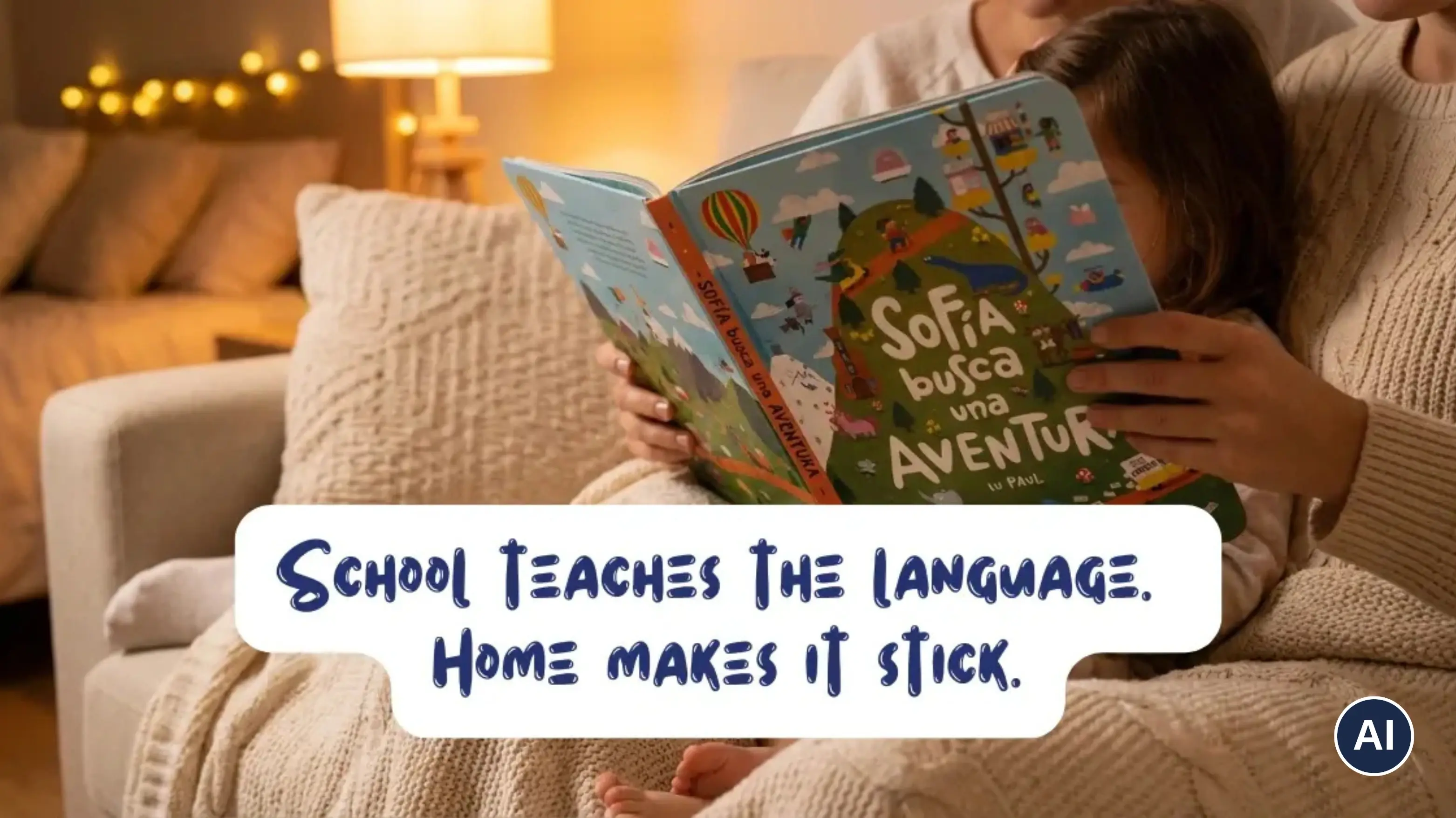
That part happens at home. And more specifically, it happens on the couch, in bed, on someone’s lap — with a book.
What School Does Well (and What It Doesn’t)
A good dual-language program teaches your child to read, write, conjugate, and comprehend in Spanish. It gives them structured instruction, peer interaction in the language, and academic vocabulary they’d never pick up at home. For families who have access to one, it’s an incredible advantage.
But here’s what school can’t do: it can’t make Spanish feel like home.
School teaches Spanish as a subject — something with rules, assessments, and expectations. Even the best immersion programs operate within a framework of academic performance. And for kids navigating two languages, especially kids who already feel the gravitational pull of English from every direction, that academic framing can start to feel like work.
Research on bilingual identity and emotional development consistently shows that a child’s emotional connection to a language — whether it feels warm, safe, and personal — is one of the strongest predictors of whether they’ll continue using it into adolescence and beyond. Children who associate their heritage language with family closeness and positive experiences are significantly more likely to maintain it. Children who associate it primarily with school? Not so much.
This isn’t a knock on schools. It’s a recognition that schools and homes serve different functions in a child’s bilingual development. School provides the structure. Home provides the soul.
Why Home Reading Is the Difference-Maker
Study after study on bilingual children shows that home reading predicts language outcomes independent of schooling. That means even after accounting for the type of program your child is in, how much you read at home — and how consistently — adds a measurable layer of benefit on top.
One study of Spanish-English bilingual children found that greater Spanish use at home made significant contributions to children’s Spanish vocabulary and reading comprehension — even for families living in English-dominant communities where English was the primary language at school. Even limited home use made a measurable difference.
Another study found that parents reading to their child just once a week had a positive impact on bilingual narrative development during early school years. Not every day. Not with perfect pronunciation. Once a week.
And here’s the finding that really matters: shared book reading at home doesn’t just build vocabulary. It exposes children to social and emotional concepts — empathy, perspective-taking, family dynamics — in their heritage language. These are the experiences that make a language feel personal, not academic. They’re the reason your child will choose to speak Spanish to their own kids someday.
The Identity Piece Schools Can’t Touch
For heritage families, this is about something deeper than language skills. Research on immigrant families consistently shows that when children lose proficiency in their home language, family cohesion suffers. Communication becomes difficult. Cultural continuity breaks. The parent-child relationship loses a dimension that can’t be replaced by English.
Bilingual parents across backgrounds — Mexican-American, Chinese-American, and many others — consistently report that maintaining their home language is essential for cultural competence and family connection. They associate losing the language with losing connection to identity itself.
School can’t carry that weight. A teacher, no matter how talented, can’t replicate the emotional texture of a parent reading a Spanish book to their child at bedtime. The warmth, the closeness, the association between language and love — those get built in private, quiet moments. Not in classrooms.
For English-speaking families building bilingualism, the identity piece works differently but the principle is the same. Your child’s relationship to Spanish is shaped by where they experience it. If they only encounter it at school, it stays academic. If they encounter it at bedtime, during story time, snuggled up with someone they love, it becomes something else entirely. It becomes theirs.
Why Parents Undervalue What They’re Doing
Here’s the irony: the parents who read to their kids in Spanish every night often feel like they’re not doing enough. They look at the families with immersion school access and think they’re falling behind. They compare their own imperfect pronunciation to a teacher’s and feel inadequate.
Meanwhile, some families with immersion school access assume the hard work is being done for them. The child is getting six hours a day of Spanish input at school — surely that’s enough, right?
Both instincts are wrong.
The family reading at home without school support is doing the single most impactful thing the research identifies: building consistent, positive, emotional engagement with the language. And the family relying entirely on school is outsourcing the part that makes the language stick.
The best outcomes, unsurprisingly, come from having both. But if you had to choose between a perfect school program with no reading at home and no school program with 10 minutes of reading every night — the research tilts heavily toward the couch.
What 10 Minutes Actually Does
Let’s make it concrete. If you read one Spanish book to your child every night for 10 minutes, here’s what that adds up to over a year:
365 books read. Over 60 hours of Spanish language input. Thousands of unique vocabulary words encountered in context. And perhaps most importantly: 365 nights where Spanish was the language of closeness, comfort, and connection.
No app does that. No classroom does that. No screen time does that.
A book does that.
The One Thing Only You Can Do
Dual-language programs are worth pursuing. Immersion camps, tutors, language apps — they all have a place. But they’re supplements to the main thing, not substitutes for it.
The main thing is this: a parent, a child, and a book in Spanish. Regularly. With warmth. Without performance pressure.
That’s the one thing no school can do. And it’s the one thing that makes everything else work better.
Make It Easy
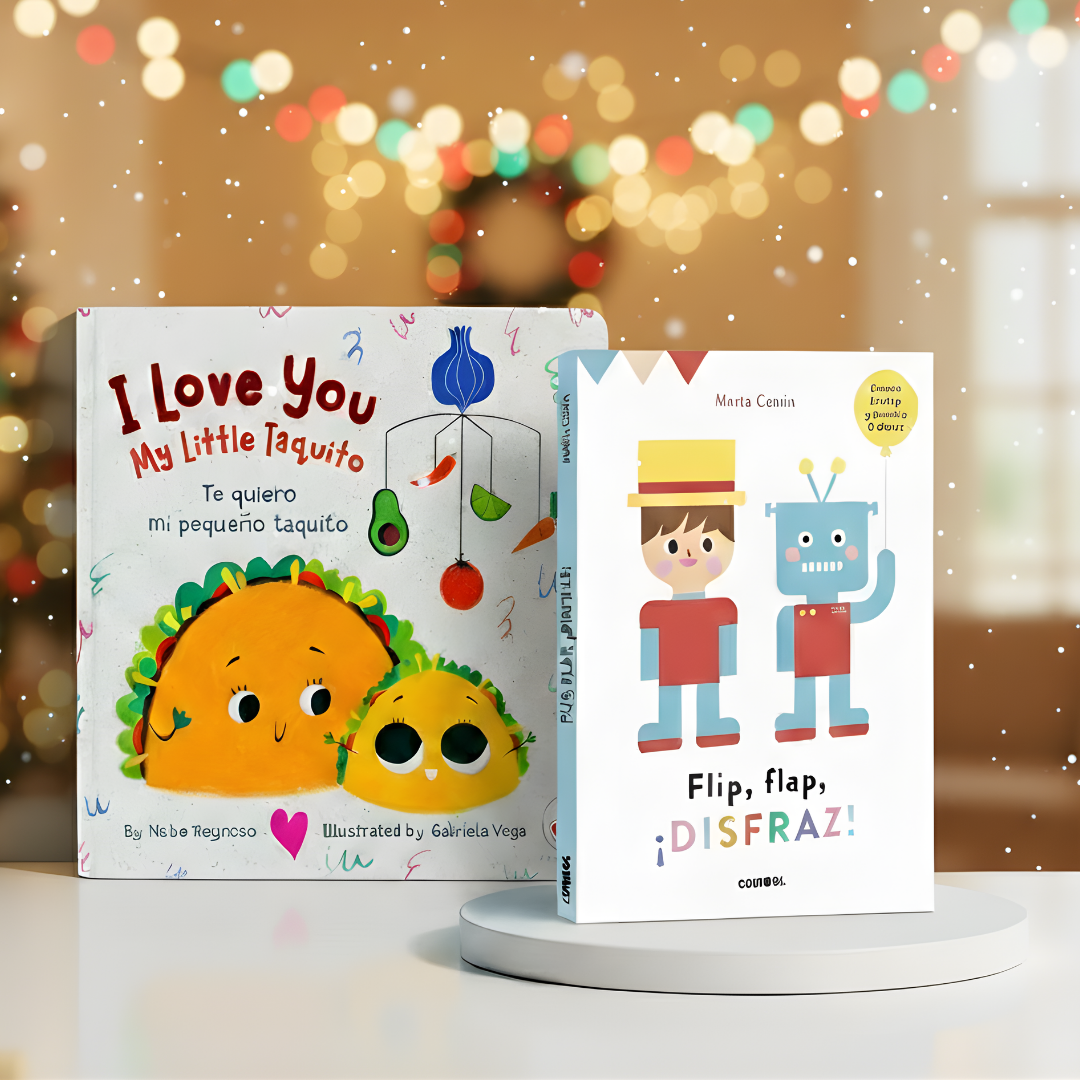
Sol Book Box delivers curated Spanish and bilingual children’s books to your door every month — hand-selected from publishers across Latin America, Spain, and the U.S.
Each book is matched to your child’s age and reading level, so the only decision you have to make is when to read it.
Because the research is clear: the most powerful thing you can do for your child’s Spanish doesn’t happen at school. It happens at home. And it starts with a book.