Most parents trying to add Spanish to their child's day end up reaching for the same set of tools. A Spanish-language cartoon at breakfast. A "learn Spanish for kids" app on a tablet. A bilingual playlist in the car. Maybe a YouTube channel with songs and sing-alongs. They're reasonable choices. The Spanish is real. The production is professional. The pronunciation is often better than what the parent could deliver themselves.
But research on how children's brains actually acquire a second language reveals something most parents don't know — and it changes how to think about every one of those tools.
The same Spanish, delivered through a recording, doesn't reach the part of the brain that learns language.
It bounces off.
The study that changed everything
In 2003, a team of researchers led by Patricia Kuhl at the University of Washington ran an experiment that should be more widely known than it is.
They took a group of nine-month-old American infants — old enough that their brains had begun specializing in English and tuning out sound contrasts that English doesn't use. They divided the infants into three groups, each of which received twelve sessions of exposure to Mandarin Chinese over the course of a month.
The content was identical across the groups. The same speakers. The same words. The same length of exposure.
What differed was the channel.
The first group heard Mandarin from live speakers — actual humans in the room, talking and playing with them.
The second group watched video recordings of those same speakers, delivering the same content.
The third group heard audio recordings, with no visual at all.
At the end of the month, the researchers tested whether the infants had developed the ability to discriminate Mandarin phonetic contrasts — the specific sound distinctions that English-speaking adults famously lose. This is the foundational work of learning any language: training the brain to perceive the sounds the language uses.
The live-exposure infants developed this ability. They could now hear sound distinctions in Mandarin that, at the start of the month, they could not.
The video-exposure infants developed nothing. Not less than the live group. Nothing. No measurable learning of those Mandarin sounds at all.
The audio-only group also developed nothing.
Same Spanish — or in this case, same Mandarin. Same content. Same duration. Three completely different outcomes, depending only on whether the source was a human being in the room.
The social switch
Kuhl and her colleagues developed a hypothesis to explain the result. They called it the social gating hypothesis. The idea is that the infant brain doesn't process all incoming sound the same way. It has a switch — and the switch is thrown by the presence of another human being engaging with the child socially.
When that switch is on, sound coming into the ears gets routed to the language-learning circuits. The brain treats it as something to acquire — to parse, to categorize, to build a model of. The phonetic patterns get extracted. The structures get noticed. The work of building the language begins.
When the switch is off, the same sound gets processed differently. It might be heard. It might even be enjoyed. But it doesn't get routed to the language-learning circuits. The brain treats it as ambient noise, or as information to consume, rather than as language to acquire.
What turns the switch on? The presence of a social partner — eye contact, joint attention, responsiveness, the felt sense that someone is communicating with you rather than at you. A live human reading aloud in Spanish triggers this. A pre-recorded video of a person doing the same thing, no matter how warm, how well-produced, or how engaging, does not. The brain knows the difference.
This is why the video group in Kuhl's study learned nothing. The Mandarin reached their ears. It did not reach the part of the brain that was waiting for language to learn.
What this means for the Spanish in your child's day
The implications for how parents think about Spanish input are bigger than most realize.
It does not mean that apps, videos, songs, and audiobooks are useless. They are not. They serve real purposes. A Spanish cartoon exposes a child to native pronunciation, to vocabulary the parent might not know, to cultural content, to the simple normalization of hearing the language. These are real benefits, and they accumulate over time.
But they are not the same as live reading. And the parent who treats them as substitutes — who thinks the Spanish cartoon is on for twenty minutes, so my Spanish work for the day is done — is, in a real sense, mistaken. The cartoon delivered Spanish. It did not deliver the kind of input that builds the foundational machinery of a bilingual brain.
That work requires a live voice.
Why this hits harder when Spanish isn't the dominant language
For a child growing up in a Spanish-speaking environment, the live-input requirement is easily met. The parents speak Spanish all day. The conversations at dinner, the questions in the car, the bedtime stories — all of it counts. The social switch is on constantly.
For a child growing up in an English-dominant household, the situation is different. The Spanish that enters the day is often pre-packaged — a song from a playlist, a video from a streaming service, a track on a kids' Spanish learning app. These tools are easier than live reading. They require no parental fluency, no time investment, no preparation. They feel productive.
But the brain processes them as ambient sound, not as language.
Which means that for a child building Spanish in a primarily English-speaking home, the few minutes of actual live Spanish — a parent reading a libro at bedtime, a grandparent reading on a video call, a babysitter playing in Spanish — are doing nearly all of the foundational acquisition work. The recorded Spanish is supplementary. The live Spanish is foundational.
This is the inversion most parents miss. The thing that feels effortful (reading aloud in a language you're not fluent in) is doing the heavy lifting. The thing that feels productive (a Spanish video on in the background) is doing much less than it appears to.
What to do with this
None of this is a verdict on any specific tool a parent has been using. Apps, videos, songs, and playlists all have their place. They expose a child to native pronunciation. They provide background normalization of the language. They give the parent a break. These are real benefits.
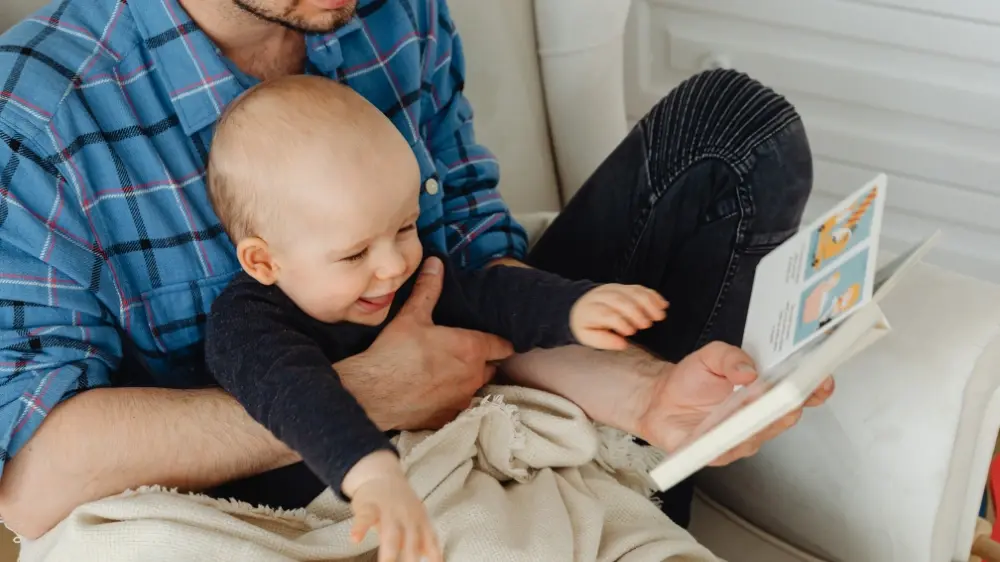
But when the question is what's the most valuable thing I can do for my child's Spanish today, the research answer is consistent: a live voice, reading or talking, with the child paying attention. Even if it's only ten minutes. Even if your Spanish is uncertain. Even if you stumble over the words.
The cartoon is not a substitute for that. The app is not a substitute for that. The audiobook is not a substitute for that. The brain is doing different things with each of those inputs, and only one of them is building the language.
If you have bandwidth for both — keep the cartoon, add the bedtime read. The recorded input does what it does. The live input does what only it can do.
If you have bandwidth for only one, the research is clear: choose the live one. However clumsy. Your imperfect Spanish, in person, with your child paying attention, is doing more for their brain than the cleanest professional recording can.
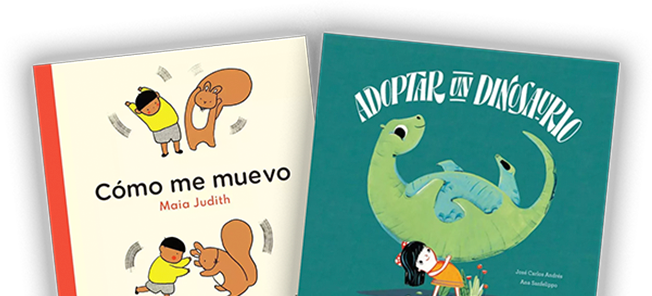
The live read matters more than parents realize. We help make it easy. Sol Book Box delivers handpicked Spanish and bilingual libros every month — the kind that earn their place in the bedtime rotation.