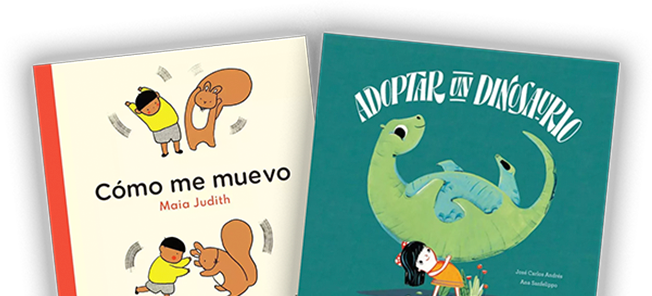
Here’s something no one tells you when you start reading Spanish books to your kids: the fact that you’re not fluent might actually be working in your favor.
That probably sounds wrong. If you’re an English-speaking parent learning alongside your child, you’ve probably spent more than a few evenings Googling pronunciation, second-guessing your accent, and wondering whether your reading is doing more harm than good.
And if you’re a native Spanish speaker, you might be thinking: Obviously my kids have the advantage. They hear real Spanish every day.
Both of those instincts are understandable. But the research on bilingual development tells a more interesting story — one where each group has a genuine superpower, and a genuine blind spot.
The Learner’s Superpower: Intentionality
When you don’t speak Spanish natively, nothing about your child’s language exposure happens on autopilot. You have to choose it. Every Spanish book you read, every storytime ritual you build, every moment you pick up a book instead of defaulting to English — that’s a deliberate decision.
And it turns out that deliberate decisions are exactly what bilingual development depends on.
Researchers studying family language policies have found that structured, intentional exposure — things like dedicated reading time, consistent book choices, and planned routines — is one of the strongest predictors of a child’s language development. Not the parent’s fluency level. Not their accent. Not whether they grew up speaking the language. What matters most is whether the exposure is consistent, purposeful, and tied to something the child enjoys.
A study on heritage language maintenance found that among families trying to pass down a minority language, those whose children developed active language skills almost universally had what researchers call “formal language exposure” — structured, deliberate engagement like guided reading and planned cultural activities. Families who relied solely on informal, ambient exposure tended to produce children with only passive understanding.
In other words: the thing English-speaking parents often feel insecure about — the fact that they have to work at it — is actually the thing that makes it work.
The Heritage Family’s Superpower: Immersion
Now, before anyone takes this the wrong way: growing up hearing Spanish every day is an enormous advantage. It’s an advantage that no amount of intentional reading can fully replicate.
Children in Spanish-speaking households absorb phonology, rhythm, and the emotional texture of the language in ways that are almost impossible to teach. They develop native-sounding pronunciation. They internalize the cadence of real conversation. They understand the cultural context behind the words.
That’s a gift. A profound one.
But here’s where the research gets uncomfortable: immersion alone, without structured literacy support, doesn’t guarantee biliteracy. A child can grow up hearing Spanish fluently while still struggling to read it. And in the United States, where English dominates school, media, and peer interactions, that gap tends to widen over time.
Studies on heritage language loss show that without deliberate reinforcement, children’s active skills in their home language often decline significantly by school age. Many end up with what linguists call “passive bilingualism” — they can understand the language but can’t produce it fluently, especially in writing. Research suggests this kind of language loss typically happens within one and a half to two generations.
The culprit isn’t lack of love or lack of exposure. It’s the assumption that exposure is enough.
The Blind Spots
For English-speaking parents, the blind spot is confidence. You doubt whether your imperfect Spanish is doing any good. You worry about mispronunciation. You compare yourself to native speakers and feel like you’re falling short. The research says you’re almost certainly underestimating the impact you’re having.
For heritage families, the blind spot is assumption. When Spanish fills the house naturally, it’s easy to believe the work is already done. And for spoken language, that instinct is largely correct. But literacy — the ability to read, engage with, and eventually produce written Spanish — requires something more intentional. It requires books.
Bilingualism researchers have consistently found that the amount of dedicated reading in a minority language is one of the strongest predictors of a child’s vocabulary and literacy in that language — separate from, and in addition to, the effects of conversational exposure. In one study of Spanish-English bilingual families, shared book reading frequency in Spanish specifically predicted children’s Spanish vocabulary, even after controlling for how much Spanish the child heard in everyday conversation.
Said plainly: talking to your kids in Spanish builds their ears. Reading to them builds their minds.
What Both Groups Can Learn From Each Other
The beautiful thing about this research is that it doesn’t declare a winner. It points to a combination.
If you’re an English-speaking parent: stop apologizing for your accent and start celebrating your intentionality. Every time you sit down with a Spanish book, you’re doing exactly what the research says matters most: creating consistent, structured, enjoyable language input. Your child doesn’t need you to sound like a native speaker. They need you to show up with a book.
If you’re a heritage family: your child already has the single biggest advantage in bilingual development — daily immersion in the real language. The one piece you might be underinvesting in is structured reading. Not because what you’re doing isn’t working, but because adding intentional book time can be the difference between a child who understands Spanish and one who reads it.
Why Books Are the Great Equalizer
Here’s what makes reading so powerful: it works regardless of the parent’s fluency level.
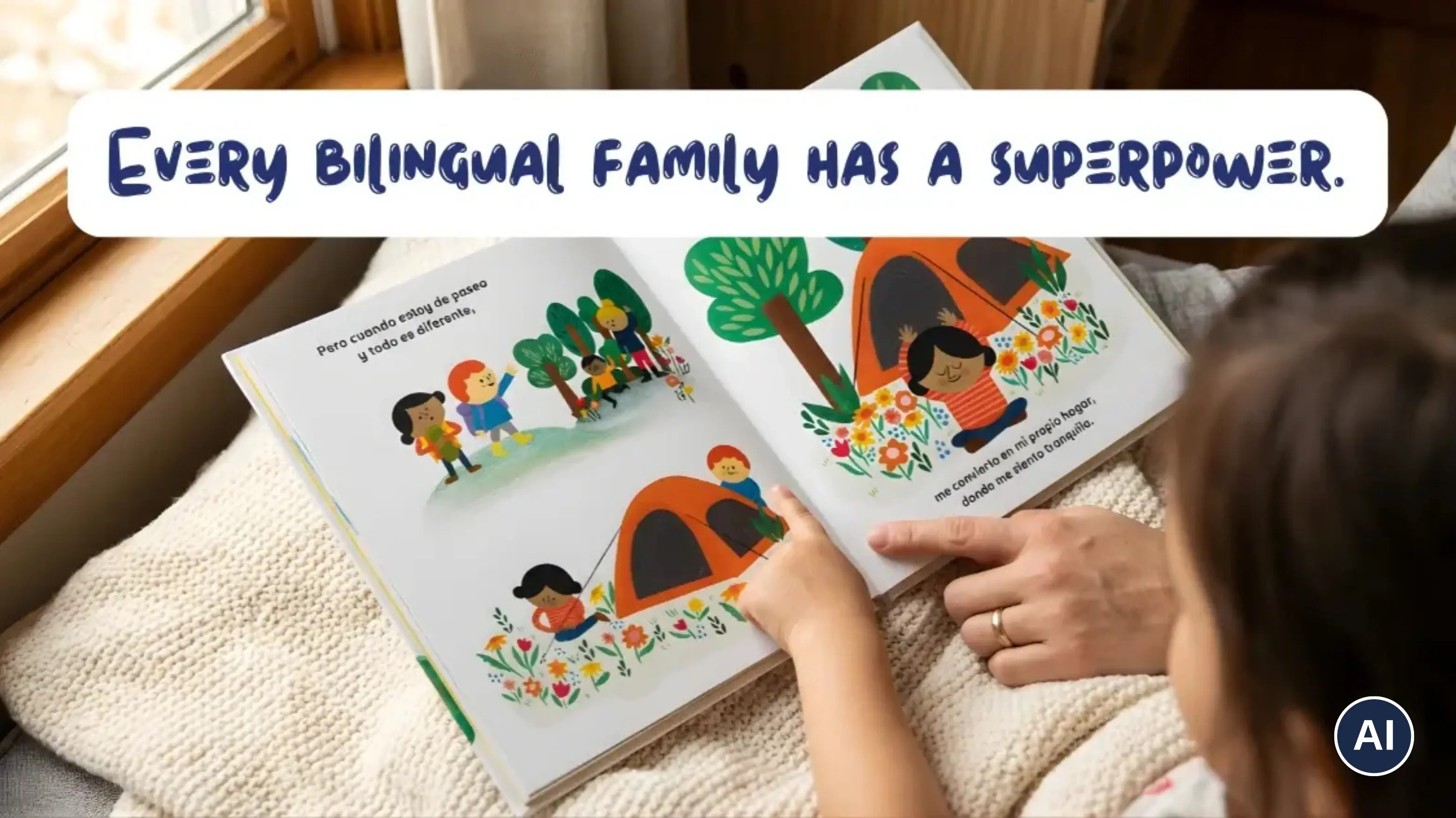
When you read a picture book to your child in Spanish, the language on the page is always correct. The vocabulary is rich, the grammar is sound, and the storytelling carries emotional weight that flashcards and apps can’t replicate. Your child isn’t learning from your Spanish. They’re learning from the book’s Spanish — and you’re the one making that experience happen.
For native speakers, reading adds a dimension that conversation alone can’t: exposure to formal language patterns, literary vocabulary, and the rhythms of written Spanish. These are the building blocks of literacy, and they’re distinct from what children absorb through everyday talk.
For English-speaking parents, reading is the ultimate equalizer. You don’t need perfect pronunciation. You don’t need to conjugate on the fly. You need a good book, a child on your lap, and 10 minutes.
Start Where You Are
Whether you grew up dreaming in Spanish or started learning it when your child did, you’re already doing something most parents don’t: you’re choosing to raise a bilingual reader.
The research says the biggest factor in your child’s bilingual success isn’t which group you belong to. It’s whether you make language exposure intentional, consistent, and tied to something your child loves.
For most families, the simplest version of that is a good book at bedtime.
--
Sol Book Box sends curated Spanish and bilingual children’s books to your door every month — hand-selected from publishers across Latin America, Spain, and the U.S.
Whether you’re building your family’s bilingual library from scratch or adding to one that’s been growing for years, we find the books so your only job is reading them.