It starts small.
Maybe your three-year-old corrects your pronunciation of mariposa — gently, the way you’d correct someone mispronouncing your name.
Maybe your five-year-old reads a word off a menu that you didn’t know. Maybe your second-grader comes home from school and tells a joke en español and you realize you only caught half of it.
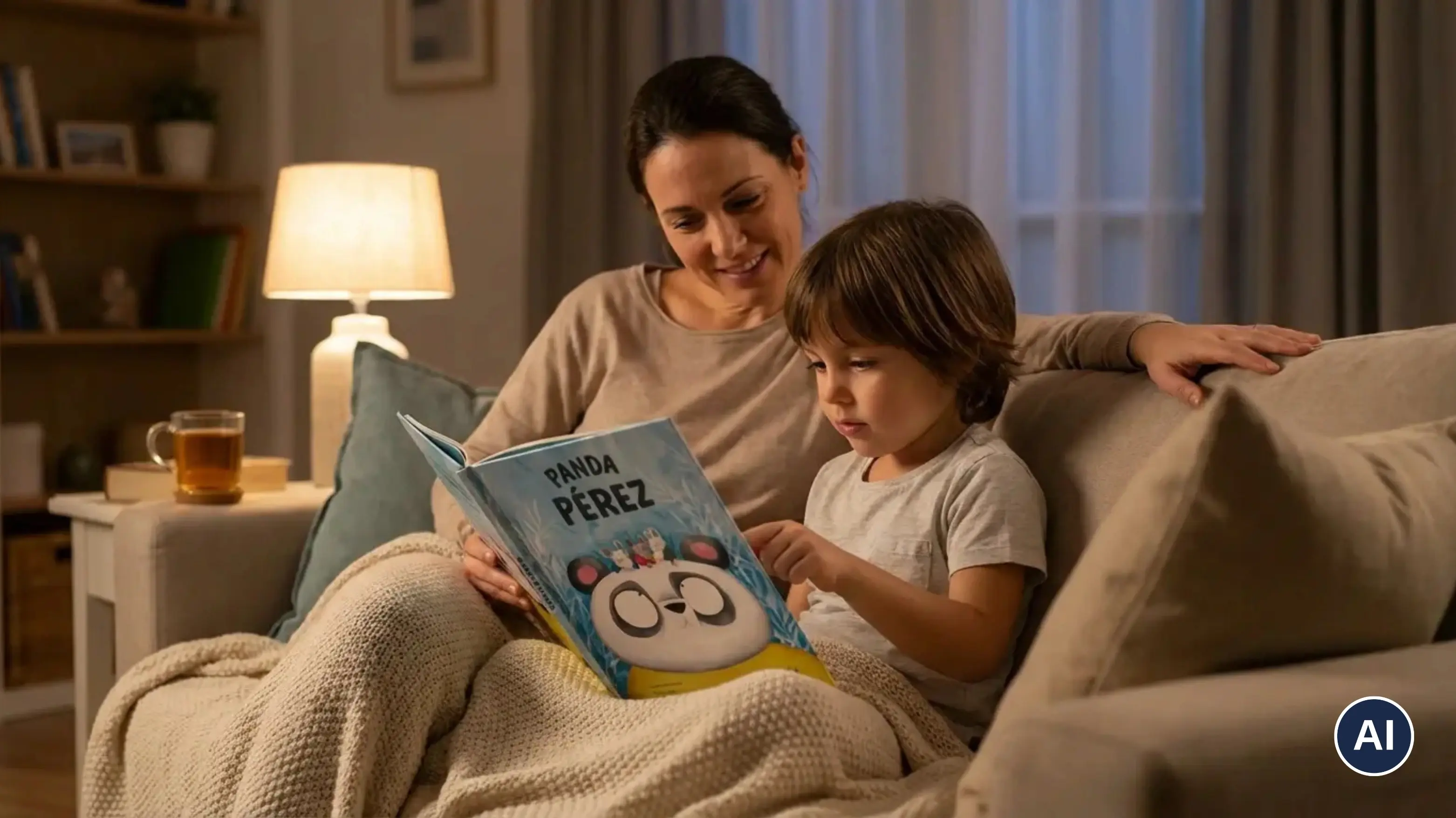
Or maybe it’s subtler than that. You’re reading a book together — a book you’ve read a hundred times — and somewhere between pages four and five, it hits you: your child isn’t listening to your Spanish anymore.
They’re reading it themselves.
And the way they say the words sounds different from the way you say them. It sounds… better.
There’s a moment in every bilingual family’s story when the balance shifts. When the child stops being the learner and starts becoming the speaker. When Spanish stops being something you’re giving them and starts being something that’s theirs.
It looks different in every family. But the feeling? That’s universal.
The Shift Nobody Prepares You For
If you grew up speaking Spanish and your child is now surpassing you in certain ways — reading more fluently, using vocabulary you’ve forgotten, correcting your grammar with the confidence of someone who doesn’t yet know grammar is supposed to be hard — it’s a lot to take in.
There’s pride, obviously. A deep, almost disbelieving pride. The language you spoke at home, the books you read at bedtime, the decision to keep speaking Spanish even when the world around you defaulted to English — it worked. Your child is carrying a language that so many families lose across generations.
That’s not small.
And if the pride comes with something more complicated — something quieter, harder to name — that’s okay too. A lot of bilingual parents describe feeling both things at once. It doesn’t mean something went wrong. It means what you built was real enough to grow beyond you.
The Planned Surpassing
For English-speaking families who introduced Spanish intentionally — through books, through school, through sheer persistence — the shift lands differently. You planned for this. You always knew they’d surpass you.
That was the whole point.
But knowing it would happen and actually experiencing it are two different things.
It’s one thing to read a bedtime story in your careful, studied Spanish. It’s another thing entirely to hear your child read it back to you — effortlessly, with a rhythm and ease that your Spanish will never have. It’s humbling. It’s also exactly what you were building toward, even on the nights when you doubted whether any of it was working.
Here’s the thing no one tells learner parents: the goal was never for you to be the fluent one. The goal was to create the conditions in which your child could become one. Every mispronounced word, every halting bedtime read-aloud, every Google Translate moment — those weren’t failures. They were scaffolding. And now you’re watching your child climb past it.
Even Fluent Parents Feel It
You might assume this moment only belongs to families where someone’s Spanish is imperfect. But fluent parents feel it too — just from a different angle.
When your child starts using Spanish in ways that are distinctly theirs — mixing it with English in patterns you never would, inventing phrases, choosing it as their language for certain emotions or situations — you realize the language you gave them is becoming something new.
Something you recognize but don’t fully own.
Your Spanish might be rooted in a specific place. Mexico City. Buenos Aires. A small town in Oaxaca. Your child’s Spanish is rooted in all of that and a dual-language classroom in Texas and the books you read together and the cartoons they watch and the friend group that code-switches at recess.
Their Spanish is a living, growing thing. It’s not a replica of yours. It’s a continuation.
And that might be the most beautiful thing about raising a bilingual child: the language doesn’t stay where you left it. It goes places you couldn’t take it yourself.
What This Moment Really Means
Researchers who study bilingual families talk about something called “harmonious bilingualism” — the idea that when both languages are associated with positive emotional experiences, children don’t just learn them. They claim them.
The language becomes part of their identity, not just a skill they acquired.
That’s what the shift is. It’s not just fluency. It’s ownership.
When your child corrects your accent, they’re not showing off. They’re showing you that this language belongs to them now. When they choose to speak Spanish with a friend, or dream in it, or use it to comfort a younger sibling — they’re telling you that what you built at home became part of who they are.
Research on bilingual families consistently shows that children who feel a strong emotional connection to a language — who associate it with warmth, closeness, and home — are the ones who carry it forward. Not because someone made them. Because they wanted to.
That wanting doesn’t come from a classroom. It comes from a couch. A lap. A bedtime ritual. A book.
The Part You Built
Here’s what’s worth sitting with: wherever your child’s Spanish is going, it started with you.
Not with the school. Not with the app. Not with the tutor or the Saturday program or the immersion camp.
Those things helped. But the foundation — the emotional bedrock that made your child want to speak this language, that made it feel like home — that was you. In your living room. On your worst nights. Reading a book you’d read a hundred times, because your kid said otra vez and you said yes.
The balance may have shifted. Your child may be the better Spanish speaker now, or they may be heading there. That’s not a loss. It’s the whole point.
You didn’t raise a child who speaks Spanish. You raised a child who is a Spanish speaker. There’s a difference. And you’re the reason.
Keep the Shelf Full
The moment might be shifting, but the ritual doesn’t have to.
Sol Book Box delivers curated Spanish and bilingual children’s books to your door every month — hand-selected from publishers across Latin America, Spain, and the U.S.
Whether your child is just starting to turn the pages or already reading ahead of you, the right books keep the language growing.
Because the story isn’t over. It’s just becoming theirs to tell.
We find the Spanish books your bookstore can't.
Cancel anytime. We'll swap any book you already own.