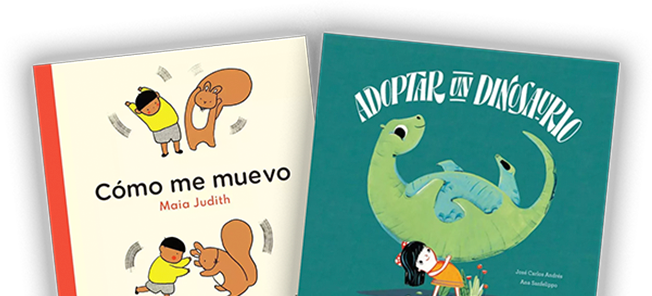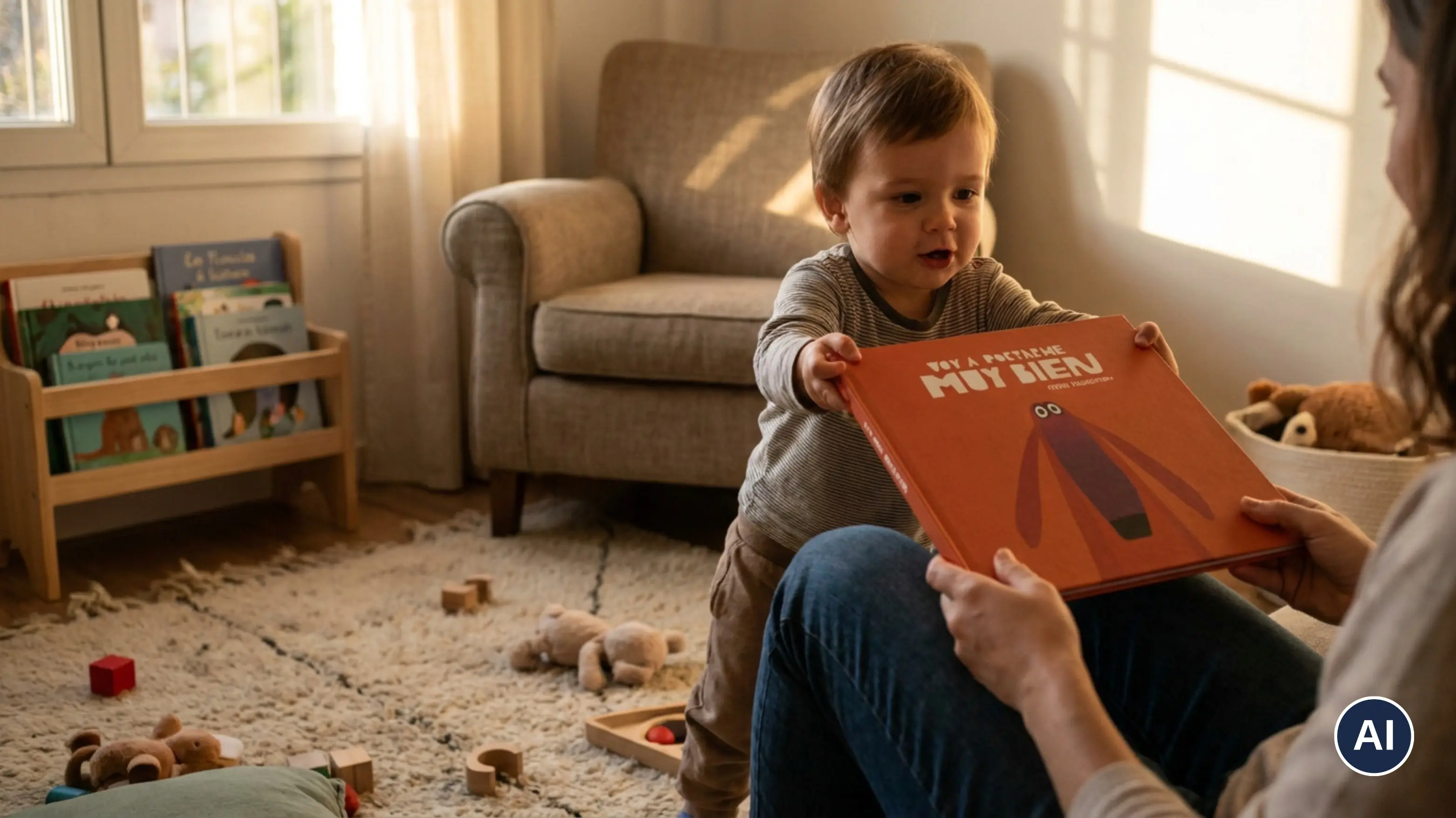
It happens around the third night.
Your child hands you the same Spanish book they handed you on Monday. And Tuesday. And the night before that. You smile, you say yes, and somewhere underneath the smile is a quiet thought you don't quite say out loud: shouldn't we be reading something new by now?
The instinct to vary the books is a good parenting instinct. Variety, exposure, breadth. Everything in the parenting environment pushes toward more.
But your toddler is making a different decision. And it turns out they know something about how the brain learns Spanish that most adults don't.
Get libros your child will ask for again & again.
Reserve your boxCancel anytime. We'll swap any book you already own.
A different book every time
A toddler reading the same book on four consecutive nights is, in a meaningful sense, reading a different book each time. Not because the words have changed. Because the brain processing them has shifted.
This isn't a metaphor. Cognitive scientists studying shared reading have identified a pattern in how attention deploys across repeated exposures, and the pattern reveals something parents almost never see: the brain doesn't reread. The brain re-processes, and what it processes on each pass is categorically different from what it processed before.
The first time through a Spanish picture book, almost all of a child's cognitive resources go to the most basic question: what is happening in this story? They're tracking the plot. Who's hiding behind the tree, what happens on the last page, why the character is sad. The brain is running its comprehension networks at full capacity, trying to build a coherent narrative from a series of pages it has never seen before. The language is one channel of input among many, and most of it slides past too fast to grab. The child isn't ignoring the words. The brain literally doesn't have the spare capacity to process them at any depth.
The second time, the surface settles. The plot is no longer a mystery. The brain offloads the question of what happens — it already knows — and that freed-up capacity finds something else to do.
It goes to the pictures.
This is the moment most parents miss. Adults read books by reading the words. Toddlers read books by reading the combination, with the pictures doing far more of the meaning-making work than adults realize. On the second read, with the plot familiar, the child's attention can settle on what the picture is actually showing — and the picture is a soundless dictionary the child is teaching themselves to read. A picture of a dog paired with the word perro is doing translation work no parent could do without breaking the spell of the language. The child doesn't need you to translate; they're translating themselves, with the picture as their reference.
But this layer, too, requires the previous one to be settled. They couldn't do this work on the first read because the plot was using all the room.
What happens on the fourth read
By the third or fourth reading, with the plot known and the pictures mapped, attention can drop another layer down. Now — and only now — the language itself becomes the focus.
And here's where the research gets specific.
On these later reads, the brain isn't just "paying more attention to the words." It's running a different program. Comprehension networks, which dominated the first read, hand off to language-processing networks: the neural systems responsible for extracting phonological, morphological, and syntactic patterns from speech. The same input is being processed by different parts of the brain.
What the child extracts on these later reads is layered, too.
They start with phonology — the sound-shape of words. The way gato sounds in your mouth. The way the vowels in despacio stretch out. The crisp ending of otra vez. The brain is cataloging the sound system of Spanish, and it can only do this work when the meaning is no longer in question. A familiar story stops competing for resources. The sounds become available for study.
Then morphology — the patterns of word formation. The reason every -ito ending feels small. The way verbs change shape depending on who's doing the action. A child won't articulate these rules, but their brain is extracting them statistically, building a model of how Spanish puts words together. This work is invisible to the parent. It's not invisible to the child.
Then syntax — the sentence frames. The way El gato está... sets up an expectation that something will follow. The shape of a question in Spanish, the rhythm of a list, the cadence of a story ending. By the fourth or fifth read, your child has heard the same sentence structures enough times to start predicting them — and prediction, in language acquisition research, is the strongest possible evidence that the structure has been internalized.
This is why a child who has heard a Spanish book five times will sometimes start to mouth the words along with you. Not because they've memorized the story (though they have). Because the brain has now extracted the underlying pattern of the language enough to anticipate what's coming. The book has done its job.
A new book, however good, can't deliver this. The first read of any book is spent on plot. The language layer doesn't open until the fourth or fifth pass.
Why this matters more in Spanish
Everything described so far is true for monolingual children too. But it matters more — sometimes dramatically more — when the language being learned isn't the family's dominant one.
A child building English vocabulary at bedtime is hearing English all day. The reinforcement of a new word from a book is one of dozens of opportunities to encounter that word in the next 24 hours. Frog shows up in the bath toy, the cartoon, the conversation at the park, the song in the car. The natural redundancy of the environment is doing the layered processing work that, for a monolingual child, doesn't have to happen inside the book itself.
A child building Spanish in a primarily English-speaking home doesn't get that loop. The book might be the only place rana shows up that week. Which means the deeper layers — the phonological cataloging, the morphological pattern extraction, the syntactic prediction — have to happen inside the rereading sessions themselves. The environment isn't going to deliver them anywhere else.
For a child learning Spanish in the U.S., the layered reading isn't a nice-to-have. It's structurally how the language gets built. And it can only happen on the fourth or fifth read, when the brain has finally cleared enough capacity to do the work.
This is the part adults almost universally underestimate. When we look at a child rereading a Spanish book for the fifth time, we see comfort. The brain sees opportunity. The fifth read is the first time the language layer has had any room to breathe — and in a non-immersive environment, it may be the only chance that week to do this work.
The decision your toddler is making
There's something worth noticing in the behavior of toddlers, which is that they figure this out before we do.
When a three-year-old reaches for the same book again and again, they're not being inflexible. They're not stuck. They've moved through the plot. They've absorbed the pictures. They want the language now, and they know which book is going to give it to them.
They are making an optimization decision you couldn't have made for them. You don't know which layer they're on. They do.
When you say yes, you're not indulging them. You're cooperating with a process they're already running.
Variety is what makes this possible
A reasonable question at this point: if four nights of the same book is doing this much work, why bring in new books at all?
Because the layered reading only works when the book in question is worth layering on.
A child can only pull rana out of a book that contains rana. They can only extract a sentence frame they've encountered. They can only practice phonological discrimination on the sounds they've heard. The bedtime favorite — the one they're processing on the fourth pass — only exists because at some earlier point a new book entered the field, was tested, and earned its place.
Every favorite was a fresh book once.
The bedtime rotation is small by design: three or four books your child reaches for again and again. But it's drawn from a much bigger pool. And the pool has to refresh, because your child is changing. The book that hit the layering sweet spot at two-and-a-half won't be the book that hits it at three. The vocabulary they're ready to extract is moving. The sentence structures they can predict are evolving. A static shelf produces stagnant rotation.
Variety and repetition aren't competing instincts. They're doing different parts of the same job. Variety produces the candidates. Repetition produces the language. Your toddler is running the second part of the system. The first part — keeping the field stocked with books worth choosing — is yours.
What to do with this
The next time your child slides the same libro across the bedspread, you can stop apologizing — to yourself, to whatever invisible parenting standard says you should be doing something different.
You don't know which layer they're on. They do.
Say yes. Read it again. Let the lesson finish.
And when you find yourself looking at the shelf wondering whether it's time to add something new — that's your part of the system. Trust your child to do theirs.