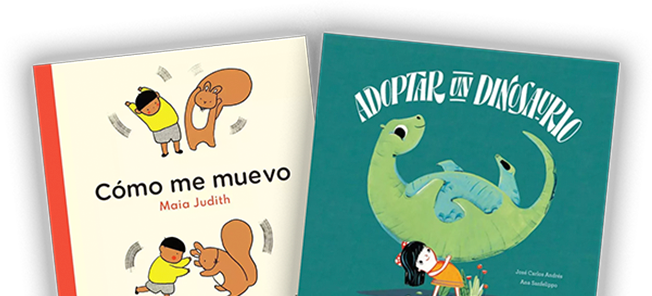
Short, calming stories that a child hears again and again are what make bedtime work for a bilingual reader. Once a child knows how the story goes, they stop spending attention on what happens next and start spending it on the words. Classic favorites like Los Tres Cerditos, free read-along sites, and screen-free audio all give you somewhere to start tonight. The routine below covers how to shape ten quiet minutes the same way every evening, and how to adjust it as your child grows.
Quick answers
- Familiar stories like Los Tres Cerditos and Ricitos de Oro work well because a child who already knows the plot can spend their attention on the Spanish instead of the story.
- Short, repetitive tales built around bedtime actions — bath, pajamas, lights out — link new words to what your child is already doing.
- Free read-alongs and audio from The Spanish Experiment, OLCreate, and LibriVox cover most of what a bedtime routine needs at no cost.
- Bedtime narration should be slow and calm, with no upbeat music beds or sudden sound effects.
- A five-step routine — warm-up, story, repetition, lull phrase, lights down — takes about ten minutes and works from age zero through eight.
On this page
- What are the best Spanish bedtime stories for kids?
- Where can you find free and paid bilingual bedtime stories?
- How do you use bedtime stories to build Spanish skills?
- A five-step bedtime routine
- Adjusting the routine by age
- Getting bedtime audio right
- Quick links to trusted Spanish story resources
- Frequently asked questions
What Are the Best Spanish Bedtime Stories for Kids?
The best Spanish bedtime stories share three qualities: familiar plots, gentle pacing, and language your child can partly predict. That predictability is what makes bedtime storytelling in Spanish so effective for language growth, not flashcards or drills.
Classic retellings do a lot of heavy lifting here. Stories like Los Tres Cerditos (The Three Little Pigs) and Ricitos de Oro (Goldilocks) show up across text, audio, and video formats precisely because children already know the shape of the story. When a child recognizes the plot, they spend their mental energy on the Spanish vocabulary instead of trying to figure out what happens next.
For different ages and comfort levels, different formats work better:
- Classic retellings (0–8): Familiar fairy tales in Spanish, ideal because kids already know the story arc and can focus on new words instead of plot.
- Simple original tales and first-words books (0–3): Short, repetitive stories built around single concepts like buenas noches or a dormir that reward re-reading.
- Bilingual read-alouds with alternating text (3–6): Books that switch between English and Spanish line by line, easing kids into translation without confusion.
- Calming audio and read-along playlists (any age): Podcast-style narrations or slow-paced read-alongs that work when eyes are tired but ears are still awake.
Routine-themed tales deserve a special mention. Stories built around bath time, pajamas, and lights-out vocabulary pair new words directly with the actions your child is already doing, which tends to land faster than an abstract story would. If you want a starting point for reading aloud when you aren't fluent yourself, our guide to Spanish read alouds covers how to run a short session without stumbling over pronunciation.
Where Can You Find Free and Paid Bilingual Bedtime Stories?
You don't need to build a Spanish story library from scratch. A handful of reliable sources cover text, audio, and video, and most of them cost nothing.
For free options, start here:
- The Spanish Experiment offers read-along Spanish stories with audio support, useful for practicing pronunciation alongside your child.
- The Fable Cottage publishes bilingual fairy tales with slow, native-speaker audio, which helps when you want to model correct pacing yourself. A set of Spanish stories is free; the full library is a paid membership.
- OLCreate maintains a curated list of free bilingual bedtime resources, including short stories, audiobooks, and podcast recommendations for ages 3 to 6 and up.
- LibriVox offers free, volunteer-read audiobooks, some in Spanish, which work well as calming background narration.
- Your local library's app gives you fast access to bilingual titles with no purchase at all, and most systems now carry a digital Spanish collection alongside the English one.
For paid options, independently published bilingual audiobook collections aimed at ages 3 to 6 give you short, soothing tracks without the search time. Podcast apps and Kindle Unlimited both carry bilingual children's titles as well. Audio-only formats tend to work best in the final ten minutes before sleep, when a screen would do more harm than good.
How Do You Use Bedtime Stories to Build Spanish Skills?
A short, consistent routine paired with calm narration beats any flashy app or drill session. The reason is simple: bedtime already comes with built-in bonding and predictable timing, and predictable language patterns are exactly what young brains use to build vocabulary without effort.
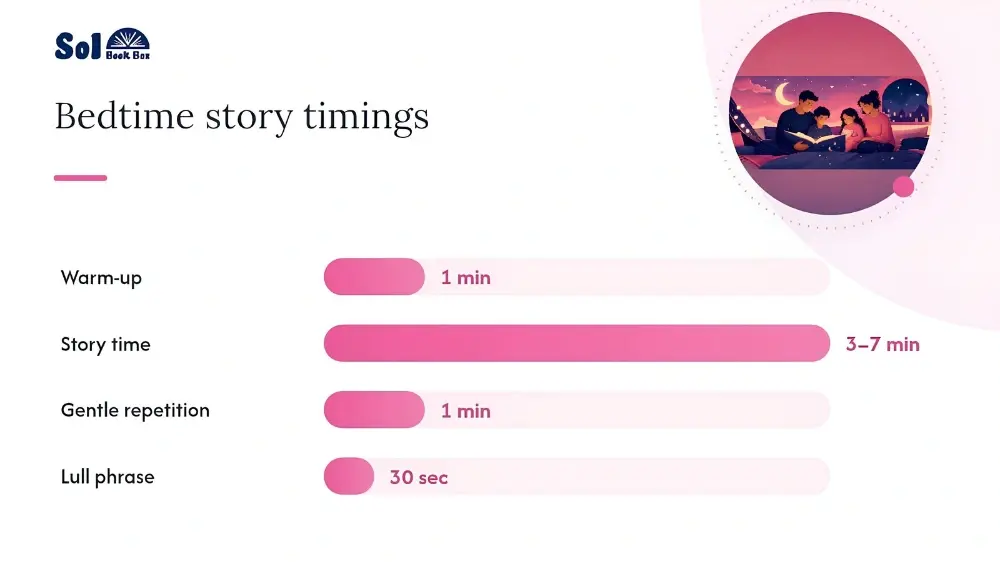
A Five-Step Bedtime Routine
Here's a routine you can start tonight. Start to finish, it runs about ten minutes.
- Warm-up (1 minute): Say a simple Spanish phrase you use every night, like ¿Listos para el cuento? ("Ready for the story?").
- Story time (3–7 minutes): Read or play one short story, in Spanish or bilingual format, at a slow, even pace.
- Gentle repetition (1 minute): Repeat two or three target words from the story out loud, pointing to pictures if you have them.
- Lull phrase (30 seconds): Close with the same calming Spanish phrase every night, such as Buenas noches, dulces sueños.
- Lights down: End the routine in the same order every time so your child's brain learns to associate Spanish with winding down.
Adjusting the Routine by Age
For ages 0 to 2, stick to short picture and board books with tactile pages and single words per page. Our guide to picture books versus board books covers which format suits which stage.
For ages 3 to 5, simple repetitive phrases and short bilingual lines work best, since kids this age thrive on hearing the same sentence structure night after night.
For ages 6 to 8, you can stretch to short chapter-style bilingual read-alouds or longer audio tracks, since attention spans and vocabulary have grown. If your reader is heading into school, our guide to choosing Spanish books for kindergarten picks up from there.
Getting Bedtime Audio Right
Screen-free playlists and podcasts are excellent for winding down, but the narration needs to be slow and calm, with minimal background music.
Pro tip: Skip any bedtime audio with upbeat musical beds or sudden sound effects. Even a cheerful jingle between story segments can jolt a drowsy child back to alertness right when you want them settling down.
Keep all of this in perspective. Bedtime doesn't need to carry your whole bilingual plan. Treat it as one low-pressure, high-bonding slice of exposure inside a broader mix of English and Spanish across the day.
Quick Links to Trusted Spanish Story Resources
- The Spanish Experiment: Free read-along Spanish stories with audio support.
- The Fable Cottage: Free Spanish fairy tales with slow, native-speaker audio.
- OLCreate bilingual bedtime collection: Curated free stories, audiobooks, and podcasts for kids.
- LibriVox: Free volunteer-read audiobooks, including Spanish titles.
Frequently Asked Questions
What are some good bedtime stories in Spanish?
Classic retellings like Los Tres Cerditos and Ricitos de Oro work well because kids already know the plot, plus simple routine-themed tales built around vocabulary like a dormir and buenas noches.
What is the 80/20 rule for Spanish?
In dual-language education, an 80/20 model means roughly 80 percent of early instruction happens in the target language and 20 percent in English, with the ratio evening out as children move up the grades. At home the idea translates loosely: the minority language needs a meaningful share of the day, not an occasional lesson. Bedtime is a good place to spend some of that share, because it's low-pressure and consistent.
What are some simple Spanish stories for beginners?
Look for short, repetitive first-words books focused on single concepts, or routine-themed stories about bath time and bedtime, since the predictable structure and familiar actions make new vocabulary easier to absorb.
What is the most famous Spanish story?
Among bedtime-friendly classics, fairy tale retellings such as Los Tres Cerditos and Ricitos de Oro are among the most widely adapted into Spanish and bilingual formats for young children.
Bedtime Libros, Chosen for You
Finding the right bedtime book every night is its own quiet chore, and a poorly translated one can undo the calm you just built. Sol Book Box sends a curated box of Spanish and bilingual libros matched to your child's age each month, chosen for gentle pacing, authentic language, and stories that hold up to repeat reads.
Get libros your child will ask for again & again.
Cancel anytime. We'll swap any book you already own.